
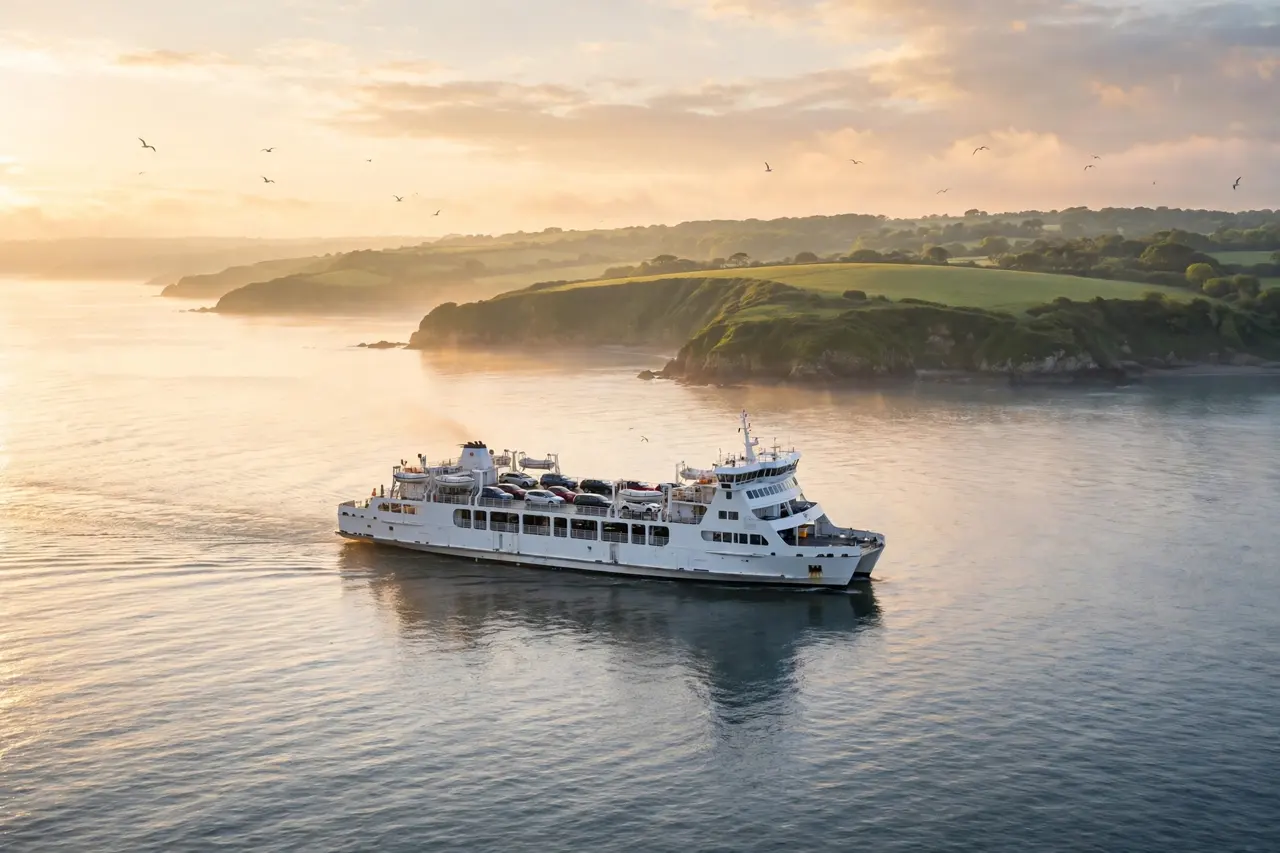

The Isle of Wight is closer to the mainland than many people realise, separated from Hampshire by a stretch of water just a few miles wide. Yet every journey to the Island begins the same way: with the Isle of Wight ferry. There is no bridge and no tunnel, so the ferry is not a novelty but the Island’s lifeline, carrying residents, visitors, delivery vans and holiday traffic across the Solent every day of the year. If you are taking your car over for the first time, this guide covers the three routes, how the crossing works in practice, and how to make the whole experience smooth from booking to arrival.
The three Isle of Wight ferry routes for cars
Drivers have three choices, and the right one depends on where you are starting from and where on the Island you are heading. The Portsmouth to Fishbourne route, run by Wightlink, is the most popular with visitors: the crossing takes around 45 minutes and lands you in the north-east of the Island, a short drive from Ryde and well placed for the east coast resorts. The Southampton to East Cowes route, run by Red Funnel, takes about an hour and is convenient for anyone coming from the M3 or the west; East Cowes sits near the middle of the Island’s north coast. The Lymington to Yarmouth route, also Wightlink, is the shortest crossing at roughly 40 minutes and the prettiest, leaving from the edge of the New Forest and arriving in the West Wight, close to Freshwater and the Needles. All three carry cars of all sizes, motorhomes and caravans, and all run from early morning until late evening, with the busiest sailings on summer Fridays and Sundays.
Booking: when to reserve and how to keep costs down
In the quieter months you can often turn up and travel on the next sailing, but booking ahead is strongly recommended from spring onwards and essential in school holidays, when popular crossings sell out. Fares work much like train tickets: the most convenient sailings at peak times cost the most, while early, late and midweek crossings are usually kinder to the wallet. Booking online in advance is normally cheaper than paying on the day, and return tickets are better value than two singles. If your plans are flexible, travelling a day either side of the weekend rush can make a real difference. Island residents and regular travellers use season tickets and discount schemes, but for a one-off holiday the simple rule holds: pick your dates, book early, and travel at an unfashionable hour if you can.
What happens on the day: check-in, loading and the crossing
The routine is straightforward. Aim to arrive at the port in good time before your sailing, typically at least half an hour ahead, and follow the signs to the check-in lanes, where your booking is confirmed and you are directed into a numbered lane. When loading begins, marshals guide vehicles onto the car deck in rows; you will be asked to apply the handbrake, switch off the engine and, on some sailings, turn off your alarm. Passengers then head up to the lounges, because nobody stays in their vehicle during the crossing. On board you will find seating areas, a cafe and, on the longer routes, outside decks that are well worth the climb: the Solent is a busy, fascinating waterway, and views back to the Spinnaker Tower or across to the Island’s chalk cliffs are part of the pleasure. Before arrival, an announcement sends drivers back down to their cars, and unloading on the Island side takes only a few minutes.
Preparing your car for the crossing
A ferry trip is gentle on a car, but a little preparation prevents the classic holiday spoilers. Make sure the car will start reliably after sitting on the deck, check your fuel or charge level so you are not hunting for a filling station the moment you land, and confirm your tyres and lights are in good order before a week of unfamiliar country lanes. Our guide to car servicing on the Isle of Wight explains what local garages can help with if something does crop up mid-trip, and the Island’s full network of workshops is covered in our overview of auto services on the Island. Coastal driving is hard on tyres in particular, with sharp bends, steep hills and salt in the air, so the checks in our guide to tyre services for coastal roads are worth doing before you sail. If the worst does happen and a repair lands during your stay, our explainer on managing unexpected car repair costs will help you keep it in perspective.
Arriving on the Island: your first drives
Driving on the Isle of Wight is one of its pleasures. The roads are quieter than the mainland’s, the distances are short, and almost anywhere on the Island is within about half an hour of anywhere else. Do expect narrow lanes, the odd tractor, and speed limits that drop to 20 or 30 through the villages. Many visitors head straight for the Military Road along the south-west coast, one of England’s great scenic drives, with the sea on one side and downland on the other. If you are bringing a hybrid or electric car, you will find charging points at larger car parks and attractions, and our guide to hybrid servicing and travel on the Isle of Wight covers what island driving asks of these cars. Those thinking of making the move permanent will also find our guide for Isle of Wight car buyers a useful companion.
Bikes, roof boxes, trailers and dogs
A few practical extras are worth knowing before you book. Cars carrying bicycles on rear racks or roof boxes should declare their full height and length when booking, because vehicle dimensions affect the fare and where you are placed on the deck. The same applies to trailers and caravans, which are welcome on all three routes but need to be included in the booking rather than arriving as a surprise. Dogs travel happily on these crossings: they are allowed in designated pet areas on board and in the passenger lounges on some services, and many owners simply build the crossing around a good walk at either end. Foot passengers and cyclists use the same ports, with fast passenger catamarans from Portsmouth and Southampton for those leaving the car behind, so a mixed group can split up and meet on the Island side without difficulty.
The Isle of Wight ferry is more than transport; it is the moment a holiday properly begins, when the mainland slips behind you and the Island comes into view. Choose the route that suits your journey, book ahead in busy periods, arrive in good time, and let the crossing do the rest.