
Beauty research is changing how consumers, professionals and cosmetic brands understand skincare, cosmetics and personal care. Behind many modern beauty products is a combination of laboratory science, ingredient testing, consumer research, formulation work and, for certain claims or interventions, clinical investigation. Understanding this evidence can help people look beyond viral claims and make more informed decisions about the products and treatments they choose.
The beauty industry moves quickly, but scientific research tends to require a more careful approach. An ingredient can attract attention online long before there is enough evidence to understand its benefits, limitations or appropriate use. For that reason, learning how beauty science works is increasingly valuable for anyone trying to separate useful information from marketing hype.
What Is Beauty Research?
Beauty research covers a broad range of scientific and consumer-focused work related to cosmetics, skincare, haircare, fragrance and personal care. It can involve studying individual ingredients, developing formulations, evaluating product performance, understanding skin biology or examining how consumers perceive beauty products.
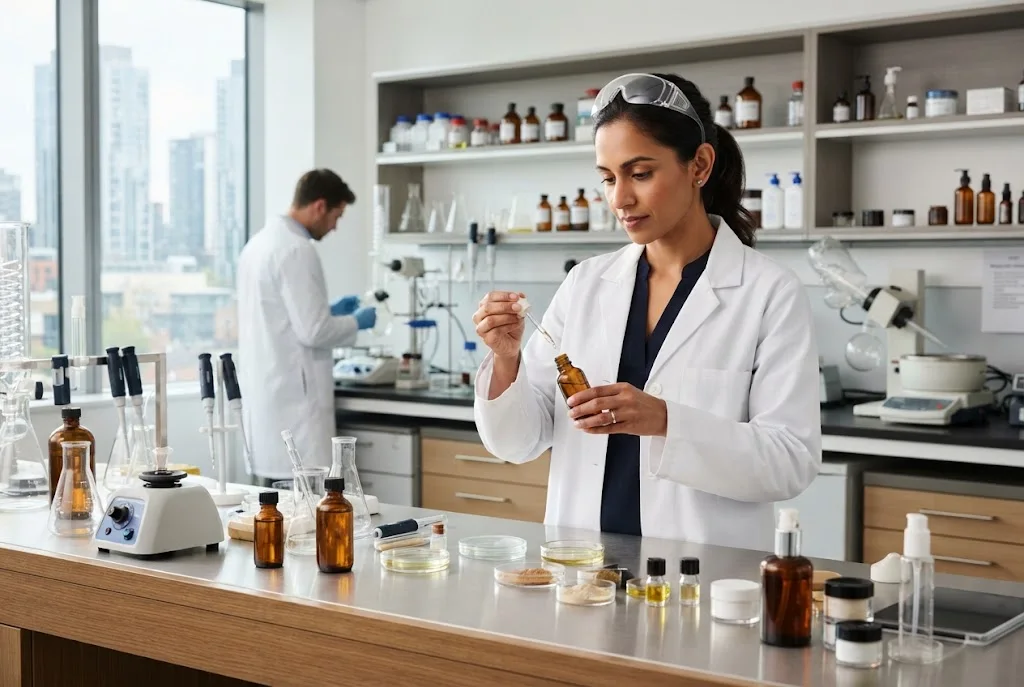
The term can therefore describe very different types of evidence. Laboratory research may examine how an ingredient behaves under controlled conditions, while a clinical study may investigate how a finished product performs when used by people. Consumer research, meanwhile, can explore preferences, perceptions and purchasing behaviour.
These distinctions matter because one type of research cannot automatically answer every question. Evidence about an ingredient does not necessarily prove that every cosmetic containing it will produce the same result.
Beauty Science and How Skincare Products Are Developed
Beauty science combines disciplines such as chemistry, biology, formulation science and material science. Cosmetic formulators use this knowledge to create products that are stable, usable and capable of delivering the intended cosmetic experience.
A skincare product is rarely just a collection of individual ingredients. The formulation determines how ingredients are combined, how the product feels, how it remains stable and how consumers are expected to use it.
This is why two products containing a similar headline ingredient can still provide different experiences. Their concentrations, supporting ingredients, formulation systems, packaging and intended application may differ considerably.
For consumers, this is an important reminder that an ingredient list should be considered in context rather than treated as a simple ranking of good and bad ingredients.
Why Skincare Research Matters to Consumers
Skincare research can help answer questions that marketing alone cannot. Consumers may want to know whether a particular ingredient has evidence supporting a cosmetic benefit, how frequently a product should be used or whether a claim has been investigated under controlled conditions.
Research can also help identify limitations. Scientific evidence does not always produce a simple yes-or-no answer. Results can depend on study design, participants, formulation, duration and the specific outcome being measured.
This is particularly important when a product is promoted using dramatic language. A carefully designed study may show a measurable change without supporting the much broader promise suggested by an advertisement or social media post.
As consumers explore subjects such as beauty trends UK, understanding research can provide a useful way to evaluate which emerging ideas deserve further attention.
Cosmetic Research: What Exactly Is Being Tested?
Cosmetic research can focus on several different areas. Formulators may study product stability, texture, compatibility and preservation. Researchers can also examine how a product performs on the skin or hair under defined conditions.
Depending on the purpose of the research, evaluation might involve instrumental measurements, expert assessment, consumer feedback or combinations of these approaches.
It is useful to distinguish cosmetic performance from medical treatment. A cosmetic product may be designed to improve the appearance, feel or condition of skin without being intended to diagnose, prevent or treat a disease.
This distinction becomes especially important when consumers encounter products marketed with language that sounds medical. The strength and type of evidence required to support a particular claim depend on what is actually being claimed.
Understanding Beauty Clinical Studies
Beauty clinical studies can provide more direct information about how a product or intervention performs when used by people. However, the phrase “clinical study” should not automatically be interpreted as proof that every possible claim has been established.
Study design matters. Researchers may define a specific population, usage period, comparison method and outcome before collecting results. The quality of the evidence depends partly on how well these factors are controlled.
When evaluating research, it can be helpful to ask:
- What exactly was studied?
- Who participated in the study?
- How many participants were included?
- How long did the study last?
- What outcome was measured?
- Was there a comparison group?
- Was the research conducted on an ingredient or the finished product?
- Are the results relevant to the claim being made?
These questions help prevent a common mistake: taking a narrow research finding and interpreting it as evidence for a much broader beauty claim.
Cosmetic Ingredient Research and Evidence
Cosmetic ingredient research is one of the most visible areas of modern beauty science. Ingredients can become popular because of laboratory findings, published research, industry innovation or social media discussions.
However, consumers should look at the entire evidence picture. A laboratory result may provide an interesting starting point, but laboratory conditions do not necessarily reproduce everyday cosmetic use.
Likewise, evidence involving a particular formulation does not automatically establish that every product using the same ingredient will perform identically.
This is why responsible beauty content should avoid presenting individual ingredients as miracle solutions. Scientific evidence is generally more useful when it is interpreted in the context of formulation, dosage or concentration where relevant, intended use and study design.
How to Judge Beauty Evidence
Beauty evidence exists on a spectrum. At one end may be preliminary laboratory observations or early-stage research. At another may be stronger evidence generated through well-designed studies and repeated investigation.
Consumers do not need advanced scientific training to become better at evaluating claims. A few basic habits can make a substantial difference.
Look Beyond the Headline
Beauty articles and social posts often reduce complicated findings to a single statement. Reading beyond the headline can reveal important limitations, such as the type of study performed or the population examined.
Separate Evidence From Testimonials
Personal experiences can be interesting, but testimonials do not establish that a product will work in the same way for everyone. Individual results can be influenced by many factors, including existing routines and personal characteristics.
Consider the Product, Not Just the Ingredient
A product’s complete formulation matters. The presence of a popular ingredient does not tell the entire story about how the finished cosmetic behaves or what consumers can reasonably expect from it.
Beauty Psychology: Why Some Products Feel More Effective
Beauty psychology explores the relationship between products, appearance, expectations, behaviour and perception. It helps explain why consumers may respond strongly to packaging, fragrance, texture, branding or the ritual of applying a product.
Expectations can influence how people perceive their experiences. A luxurious routine may feel more satisfying even when its primary value is sensory rather than a measurable change in skin condition.
This does not make the experience unimportant. Beauty products can provide confidence, enjoyment and a sense of routine. However, emotional satisfaction and measurable cosmetic performance are different outcomes and should not be confused.
Understanding this distinction can help consumers appreciate beauty products for what they genuinely offer without expecting every cosmetic experience to produce dramatic physical changes.
Beauty Technology Research Is Expanding
Beauty technology research is another growing area. Digital skin analysis, personalised recommendations, imaging systems and technology-assisted beauty services are changing how products and routines are selected.
Technology can potentially make personalisation more sophisticated by using information about consumer preferences or visible characteristics. However, digital recommendations still depend on the quality of the underlying system and the information being used.
Consumers should therefore view technology as a tool rather than an absolute authority. A digital recommendation can be useful while still requiring human judgement and, where appropriate, professional advice.
Research Behind Beauty Trends
Beauty trends can develop faster than scientific evidence. A product or ingredient may become fashionable through social media before researchers have had time to investigate every relevant question.
This creates a gap between popularity and evidence. A trend can be culturally significant without being scientifically established.
For example, consumers may become interested in a new skincare ingredient because creators repeatedly mention it. That interest can encourage further research, but online visibility itself does not establish effectiveness.
This is one reason the distinction between trending beauty products and evidence-supported beauty practices is valuable. Trends can introduce ideas, while research helps investigate them.
How Brands Use Beauty Research
Brands invest in research for several reasons. Product development requires understanding how ingredients behave and how formulations can deliver a consistent consumer experience. Research can also help companies evaluate product performance and support claims made about their products.
However, consumers should still examine the wording of claims carefully. Research commissioned or conducted by a company can provide useful information, but it should be interpreted according to the study’s methods and scope.
A statement such as “participants reported an improvement” means something different from a claim suggesting that a product has a guaranteed effect for everyone.
Good beauty communication should make those distinctions clear rather than relying on scientific terminology simply to make a product sound more authoritative.
Beauty Evidence and Responsible Product Choices
Research can support better purchasing decisions, but evidence is only one part of the process. Consumers should also consider whether a product is suitable for their personal needs, how it should be used and whether the cost is reasonable.
For skincare products, introducing multiple new products at once can also make it difficult to understand how an individual product affects a routine. A more measured approach can make it easier to identify what works and what does not.
When a beauty service involves a procedure rather than an ordinary cosmetic product, the decision-making process should be more cautious. Researching the practitioner, understanding potential risks and asking about aftercare can be important parts of the process.
Why Beauty Research Will Matter More in the Future
The beauty industry is becoming increasingly science-focused. Consumers have access to more ingredient information than ever, while brands are investing in formulation technology, testing and personalised experiences.
At the same time, misinformation can spread just as quickly as useful information. This makes scientific literacy increasingly valuable.
Future developments are likely to involve closer connections between cosmetic science, digital technology, consumer research and personalised beauty. The most useful innovations will need to combine attractive consumer experiences with credible evidence and responsible communication.
For readers interested in the wider cultural side of the subject, British beauty culture offers another perspective. Research explains how products and claims are evaluated, while culture helps explain why particular beauty practices become meaningful or popular.
How Consumers Can Become Better Beauty Researchers
You do not need to read scientific papers every time you buy a cleanser or moisturiser. Instead, develop a few practical habits.
- Check what a product is actually designed to do.
- Look for reliable information rather than relying entirely on social media.
- Distinguish laboratory findings from evidence involving real-world product use.
- Read claims carefully and look for limitations.
- Be cautious about guaranteed or unusually dramatic promises.
- Research unfamiliar ingredients before introducing them into a routine.
- For specialist procedures, investigate practitioner qualifications and safety information.
These habits can make beauty shopping more deliberate without taking the enjoyment out of discovering new products.
Final Thoughts on Beauty Research
Beauty research provides a valuable bridge between cosmetic innovation and informed consumer decisions. It can help explain how ingredients are investigated, how products are formulated, how claims are evaluated and why individual experiences do not always tell the whole story.
The most important lesson is that evidence needs context. A laboratory experiment, ingredient study, clinical investigation, consumer survey and personal testimonial each provide different kinds of information.
As the beauty industry becomes more connected to science and technology, consumers will increasingly benefit from understanding those differences. Rather than following every new claim or rejecting innovation altogether, informed beauty consumers can ask better questions and make decisions based on evidence, suitability and realistic expectations.